Games Art and Design

Games Art and Design

Thursday, 24 November 2016

       This week we've been looking at basic AI, getting them to do a variety of tasks such as following the player character and patrolling an area of the level.


      I used a 'pawn sensing' node for my ai, which means that it won't do any of the actions you give to it unless it sees the player.


      In order to get my ai to navigate through the entire level, I had to use nav link proxies in order for the nav mesh to become completely traversable.

Monday, 21 November 2016


      One of the main mechanics in my game is the scan function which will allow the player to see more of the environment for a brief amount of time. In order to do this, I needed to create a few blueprints that interlocked with each other.


This blueprint lies in the character blueprint, and will spawn a pulse depending on whether or not the player has enough energy, and if there isn't an active pulse already out.


The pulse blueprint. It's made of a visual aspect and a collider, that will cause a change in the material of the object.


This is the blueprint for the 'reveal' function that will allow the player to use the pulse to see.


This week, during the workshop we went through the basics of creating a character hud, and linking what is on screen to the different functions within the game.

      It wasn't too hard to design a HUD for the game that the player would be able to use, although I think that further iterations on the design might make it less 'in your face' for the player.


      This week, we looked at Variables and how we can use them to create a variety of functions within our games.
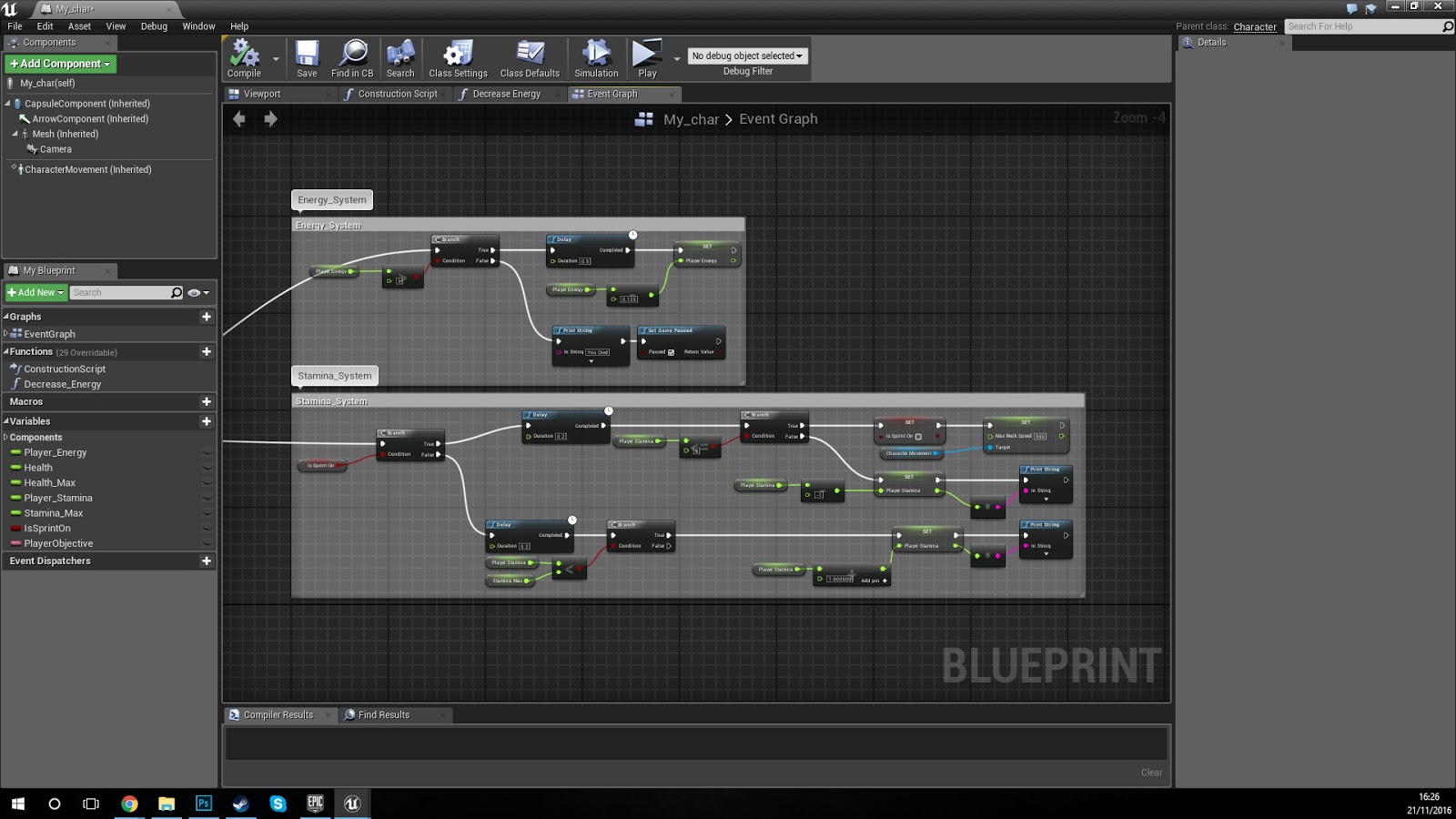
Outside of the lecture, I followed a series of tutorials that further explained some of the functionality of variables, and I ended up with a couple of systems for player resources - one for energy, the other for stamina.

      For the stamina system, I wanted to limit how long the player could sprint for, only letting them move faster while they had enough stamina. I created this system using floats and a boolean. While I could have used integers, I decided that it would be easier to make incremental changes to the values of the variables with floats. The boolean is used as a check to see if the character is sprinting, and whether or not the system should deduct or add value to the system.

      The energy system above it was much simpler to construct as I simply wanted to have the energy start at the maximum, with the energy value being constantly reduced to enable a resource management mechanic into the game.

      This is the blueprint for the energy pickups that I made - they're currently simple cubes, but that will change in the future. To start with I had to cast the object's trigger volume to the character, which would then allow the object to be picked up, removing the object afterwards so that there isn't an infinite number of energy pickups for the character to use.

      The past week I've begun to focus more on getting the game to look how I want it to, so that it can be an effective prototype. I've included models for a variety of things, as well as going through the level design for the prototype.

      The objects I made are only simple shapes that can be reused for a variety of different objects when they are morphed. For example, the energy pickups are just the crate model that I made that I then stretched in-engine.

      This has let me go from the starter content, into something that is much more inline with what I want the world to look like.


      For the title of my game, I decided to go with 'Defect', as it sums up the theme of the general narrative of how I want the game to be like, it also gave me an idea for how I wanted the character to move, which was the aim of this week's workshop.

The first stage of getting your character to move is to create some inputs in the project settings. Doing this allows you to call the function using a variety of methods, such as using a mouse/keyboard or a gamepad.


Next, is setting up the nodes within the character so that the character will react to the inputs you have just made. I had to use a float*float node on the 'pitch' input in order to have a regular looking mode, instead of having it inverted.


This image shows where I attached the camera (to the neck of the character, instead of to a camera boom). This provides a shake when walking to simulate the effects of being a defective machine, as well as allowing the player to be in a more immersive first person mode.

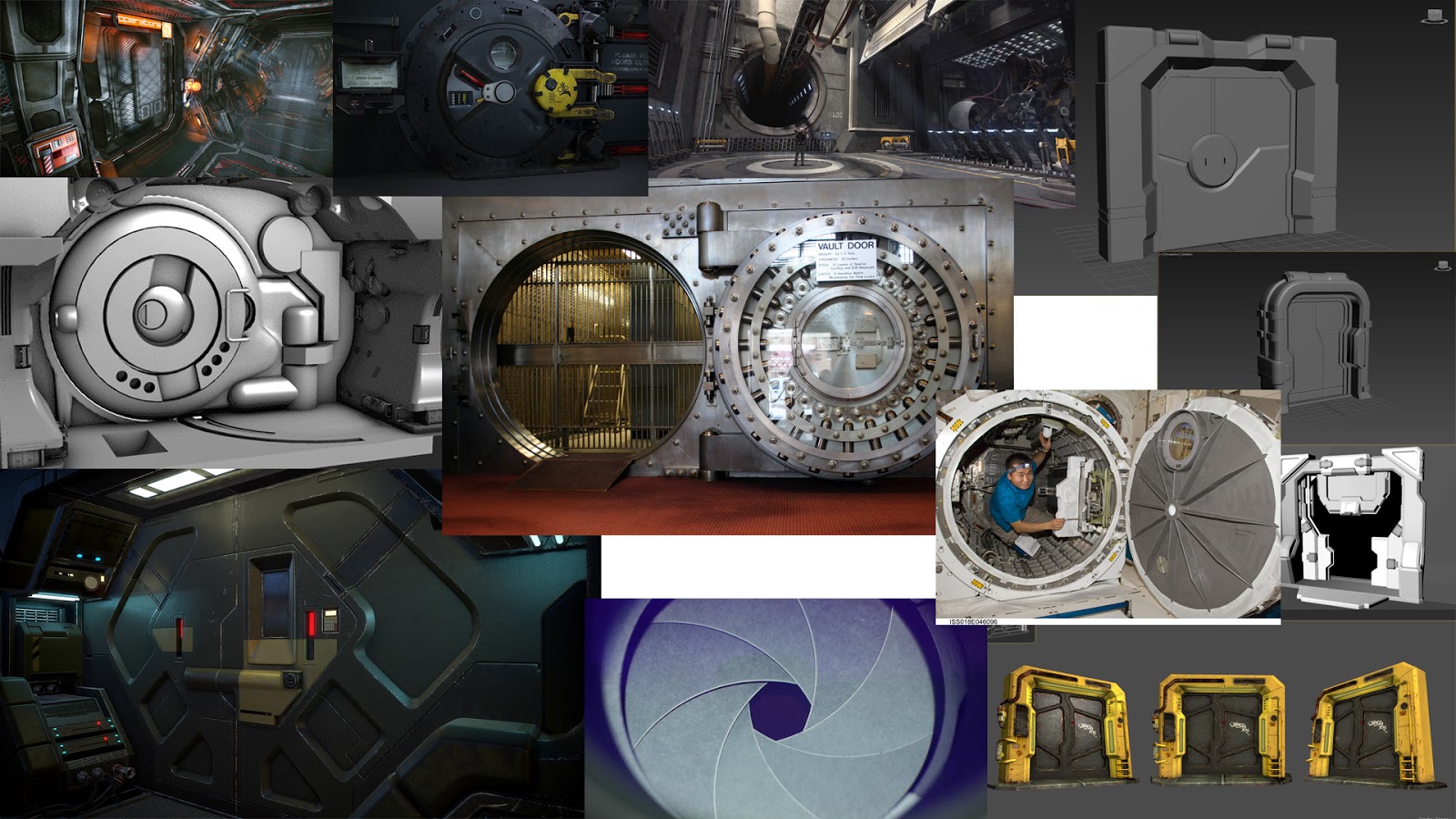
      At the same time as working on developing the prototype, i have also started to work on a 3D model, specifically a door, which will be produced as though it were going into a game, able to be blueprinted so that it can function in-game.

Wednesday, 28 September 2016

      This week we were asked to come up with at least 10 games using random words. I used a random phrase generator to come up with the titles for my games.

Macho Dinosaur Showdown:
Choose your dinosaur and begin your quest!
Experience the prehistoric world in a way never seen before. Customise your dinosaur with a variety of ‘matcho’ costumes and armours as you fight across the expansive open world of Pangaea in order to save the world from disaster (And the King of the Mammals) as you defeat increasingly difficult enemies in dark souls meets WWE style gameplay.
Consoles + PC
Teen


Birth of a New Day:
Experience the undead in a whole new way. You are a zombie, made undead against your will. You have to find the person who made you this way and take revenge while finding enough brains to keep you lucid, all without drawing attention to yourself. Make your way through this open world sandbox game with a compelling narrative that leaves you wondering ‘why?’
Consoles + PC
Teen

On The Ropes:
A tightrope dating simulator. Choose a partner and then see how well you match by walking a tightrope with the other person. Overcome obstacles and keep your balance to see how well you paired up.
Wii U
Young Adult

Keep on Truckin':
A driving game where you have to avoid other drivers who are blocking the road. It gets progressively harder as time goes on.
Consoles
All Ages

Fish out of Water:
You're a fish from the fishmongers at a supermarket that has fallen off the ice. You have to make your way back up to the ice before you go off in 'I am Bread' style gameplay.
Consoles/PC
All Ages

On Cloud Nine:
Platformer. A new drug called 'C9' has hit the streets and you've accidentally taken some, causing the world around you to constantly shift. Avoid the authorities as you try to make it home.
All Platforms
Teen+

Keep your Shirt on:
Platformer. Everytime you jump your shirt lifts up. You have to traverse the level before your shirt goes over your head and you can no longer see.
All Platforms
All Ages

No Ifs, Ands or Butts:
Brain Trainer where you have to beat your teacher through a series of puzzles to eventually leave the classroom, only to moon the rest of the class.
Hand-held Consoles
Teen+

I Smell a rat:
There's a mole in the mafia. While it isn't you, you are the main suspect. The way that you interact with other characters, and how you act in the world will affect how the NPC's view you. Find the true culprit before you get taken out.
Consoles
18+

What Am I, Chopped Liver?:
Platformer. Collect all the pieces of liver to become whole again. Defeat bosses and avoid traps along the way.
All Platforms
All Ages

Happy as a Clam:
Fighting Game. Your pearl was stolen from you while you slept. Defeat the other clams in the ring to discover which one stole it.
All Platforms
All Ages

Burst your Bubble:
Platformer. Rise to new heights by jumping from bubble to bubble, with each bubble popping after it's used. Gain power ups to leap further and be careful of environmental changes.
Mobile
All Ages

In the Red:
 Grandmother's footstep's meets mariokart. Be the first to finish the course using power ups, and avoiding the penalties caused by the random red-light, green-light system.
Consoles
All Ages

Monday, 26 September 2016


      For the Character, I want the design to be distinctly robotic, while having some human elements to not distance the player from the character too much. I feel like with the whole atmosphere of my game, it's a good idea to get the aesthetic of possibly the only entity in the game, correct.
      I really like the look of hydraulics and cabling in robots and mechs, as it gives them a little more definition, a little more believability, while also allowing from quite a bit of variance in design. I also feel like it could be a good idea to, given the supposed state of the mech, put some damage into his design, and then have that affect the way that the character moves, handicapping the player in more ways than one.


      I mainly looked at abandoned factories and warehouses to get a good idea of what I want the mood of the whole thing to be, and I quite like the muted blues and purples, mixed in with the occasional bright spot as it would change the tone from something macabre, to something far less sinister.
      Not only that, but it could be an idea that the aim of the game is to effectively return the player's sight by some means, revealing the vibrancy of the colours only after the game has finished and you've travelled however far in darkness, only able to see in black and white for the duration of the game.

      All in all, I think that these mood boards will help me to begin designing the characters and later, some of the sorts of environments that would be seen throughout the game.
      With the start of a new year, we've been given the task of creating a prototype game around the (Titular?) theme of 'Inference'.
      To help myself come up with ideas for an interesting game that I could make, I first got the explicit definition of the word:


      Inference is all about connecting implicit clues together to come to a conclusion. I think that the word can also apply to drawing information from your surroundings to have a subtly higher understanding of your environment based on what your senses are telling you.

      After a quick brainstorm, I had the idea of the player being blind, unable to see, to use their most common sense, but instead, they would use another sense to draw information on their environment. Perhaps, they would only be able to see their character through the lens of a security camera or something akin to a sonar pulse emitted from the character once every few seconds (player activated?) that would help the player to navigate their way through the level. 

      I feel as though this idea works best in a sci-fi, tech-based setting, as it would be easier to portray a robot with the ability to simultaneously see and not see (Matrix?).

      In order to get a good design for my character(s?) and the environment, I need to create a couple of mood boards, one for environment, the other for character concepts. The environment doesn't need to be particularly complex, and while neither does the character, I feel like it should be quite a colourless, drab environment. Perhaps dirty and grungy, as though it is an area that has been left to decay for too long and the character a (broken? discarded?) robot has awakened without parts of itself functioning.